Monday, February 11, 2019

The Story of Green Fluorescent Protein

This is a special guest blog article by Joel Lusk, a third-year PhD student in Biological Design at Arizona State University and a member of the Science on Main group. His research involves the study of photoacoustic contrast agents in the imaging and detection of cells. He can be reached at jlusk@asu.edu.

Have you ever seen the stories in the news where scientists make plants or animals glow? These stories are fascinating and amazing, and scientists accomplish these feats by using a protein that was originally found in a jellyfish! This protein is called Green Fluorescent Protein (GFP for short), and the story of its discovery and the scientists that originally pioneered its use is an interesting one. The protein itself has been used in science in a wide variety of applications to study plants, biological processes, and even the things that make up our cells.

Two mice expressing enhanced GFP with one non-GFP mouse in the
center. Source: Moen et al., 2012, BMC Cancer 12.1: 21.
 In 1960, a scientist named Osamu Shimomura started studying the bioluminescence of the jellyfish species Aequorea victoria. When the rings of these jellyfish are squeezed, they produce a glowing liquid. Shimomura claimed to have squeezed over a million jellyfish to collect this liquid and study it for his research. In 1962, he and his colleagues was the first to identify a protein in this jellyfish that he named aequorin. The aequorin first emits blue light, which is then absorbed by the GFP, causing it to glow.
The Aequorea victoria jellyfish. Copyright: Sierra Blakely.

Now that the protein that was responsible for the jellyfish's glow was identified, several other scientists became interested in cloning the gene responsible for it. If the gene for the fluorescent protein could be cloned and inserted into other organisms, it could revolutionize biology. In 1992 a biologist named Douglas Prasher suggested that this glowing protein could trace the way proteins moved in cells and was the first to clone the GFP gene. Unfortunately, the funding for his lab ran out and he left academia. Before he left, Prasher sent several samples of GFP to other scientists so they could continue his work.

After the genetic sequence was found for this glowing protein and it had been successfully cloned, the doors opened to a world of new possibilities for GFP. Prasher had predicted that this protein could be used as a reporter molecule in cells. This means that when a scientist wanted to know if a cell was producing a protein, they could just add the gene for GFP next to the gene for the other protein into the genetic code. When the cell produced that protein, it would also produce GFP, causing the cell to glow. This allowed scientists to undertake all sorts of amazing experiments, including the work of Martin Chalfie, who produced these proteins in E. coli bacteria and worms called C. elegans.
Neurons imaged from a "Brainbow" mouse. Source: Smith
(2007), Opinion article in Neurobiology 17.5: 601–608.

Another scientist, Roger Tsien, took the GFP and augmented it to be many different colors. He did this by changing the shape of the protein so it absorbed and emitted light at different wavelengths. This allowed scientists to not just label cells and animals with a green protein, but with an entire rainbow of colors! This has been applied to every part of the field of biology, allowing scientists to understand and see processes they never could before. Shimomura, Chalfie, and Tsien all shared the 2008 Nobel Prize in Chemistry for their work with GFP. Unfortunately, Prasher, the man who first cloned the protein, was not awarded the prize as three people maximum can share the prize. To honor him, all three recipients mentioned him in their acceptance speeches as even invited Prasher to the ceremony.

So now we know the history of GFP, but what are some of the cool things that scientists can do with it? Mainly scientists have used the protein to tag and visualize processes in cells. One amazing application of GFP and other fluorescent proteins was the production of a "Brainbow" mouse. This mouse produces a variety of colors in its neurons, allowing scientists to see the way the neurons interact with each other. Not only does this tell scientists a lot about how the brain works, it also creates a beautiful image!

The story of GFP is one that shows the usefulness of a fundamental science. Who would have thought that a protein first found in a jellyfish would go on to revolutionize the way we understand and see cells? Research into fluorescent proteins is still going strong, and scientists are currently looking at new fluorescent proteins that have been isolated from other sources such as bacteria and coral. Further work with the fluorescent proteins might reveal even more about the inner workings of our cells and our bodies. In the meantime, we can have a little fun with these proteins, and even paint pictures using bacteria who produce these fluorescent proteins across the visible light spectrum!
A picture painted on an agar plate with bacterial colonies expressing a
variety of fluorescent proteins. Source: Tsien Lab. Artwork: Nathan Shaner.
Photographer: Paul Steinbach.

Sources:

https://www.conncoll.edu/ccacad/zimmer/GFP-ww/shimomura.html
Chalfie, Martin, et al. "Green fluorescent protein as a marker for gene expression." Science 263.5148 (1994): 802-805.
Moen, Ingrid, et al. "Gene expression in tumor cells and stroma in dsRed 4T1 tumors in eGFP-expressing mice with and without enhanced oxygenation." BMC cancer 12.1 (2012): 21
Tsien, Roger Y. "Constructing and exploiting the fluorescent protein paintbox (Nobel Lecture)." Angewandte Chemie International Edition 48.31 (2009): 5612-5626.
Smith, Stephen J. "Circuit reconstruction tools today." Current opinion in neurobiology 17.5 (2007): 601-608.
http://www.tsienlab.ucsd.edu/Images.htm


Monday, February 4, 2019

"What's your Day Like?"

This blog article was written by Dr. Christina Forbes, co-founder of Science on Main. She earned her PhD in chemistry and is currently a post-doctoral researcher at Arizona State University. 

I was recently matched through Skype a Scientist with a 6th grade classroom at St. Hubert Catholic School in Minnesota. Some 40 students and their teacher got a chance to Skype with me while I was in my lab in Tempe, Arizona. I showed them around the lab a bit, but we spent most of the time just chatting about my work.

I met with 3 different class periods, and all three classes asked me a question that is surprisingly hard to answer: "What's your day like?" Since it was one of the burning-est questions these students had for me, I wanted to bring it up to Science on Main. After all, our aim with Science on Main is to answer your questions!

This question sometimes follows the classic "What do you do?" that comes up in polite conversation. I've learned that the attitude towards my accurate-but-short answer, "chemist," can range from excitement to disgust. Some people think that's cool, others think that sounds pretentious, and even others seem uncomfortable or unsettled with my answer.

Only the very curious, or confident, have asked me the follow-up: "So what's your day like?" 

Indeed, this is just my job, and it's a job I like and I worked hard to get to, but it doesn't endow me with any particular superpowers. I don't know how much people in other professions are asked this question, but I hope everyone is. There is so much fascinating stuff that can go into one person's workday. What does a software engineer do on a day-to-day basis? Or an investment banker? Or an event coordinator?

Nonetheless, these 6th graders were very curious. If you are also very curious, then I can give you a detailed approximation of my answer to "What's your Day Like?"

[Get on with it!]

On an average day, I don't function well for the first hour, so I sit at my laptop with my coffee before I attempt any chemistry. Yup, even scientists have morning commutes and laptops. I deal with emails, follow up on other emails, check my calendar for scheduled meetings, update my calendar based on the emails I got that morning, and other desk-stuff that I have to do to keep my life in order. I might edit a peer's manuscript for a paper they want to publish, or I might finish writing a draft of something that I'm working on. I might catch up on reading recent literature, like reading the news but it's only the chemistry section, written with all the jargon. When the coffee has kicked in and I think I'm a little more ready to face my day, then I'll pull out my lab notebook, put on safety glasses, and go into the lab.

My day in lab will focus on a different part of a project that I might be working on. To save chemistry jargon, I will use an analogy for my project: making a batch of THE BEST cookies for a friend. Let's say I chose, with some reasoning, to make chocolate chip cookies for my friend.

Troubleshooting a reaction:
I'll need a good recipe for the cookies. I probably looked up recipes online, maybe chose a few recipes based on reviews or ingredients that I have on hand. Maybe I asked a buddy in another lab what recipe they use, or if they have feedback on a recipe they tried. Once I have a recipe I feel good about, I do a test reaction, or a small batch. I look at the product (in this case, the cookies) to see if I could have done the reaction differently, or if this recipe is terrible and I need to try a completely different one. I'll do a series of these test reactions until I obtain the cookies I want, then I scale up the reaction and try a larger batch. Sometimes I'll have to adjust the recipe a bit more when I make a larger batch, like a longer baking time or less salt. All the while, I make notes on how I set up each batch of cookies, and how the cookies came out. What was my baking time? Baking temperature? How much sugar? Should I use honey instead of sugar? Were the cookies undercooked? Burned? Too salty? I might spend a month or more testing and perfecting a recipe for cookies in these batches.
For those of you trying this at home, this might look like running reactions, refluxing reactions, distilling materials, running a purification column, mixing chemicals, etc.

Synthesizing a molecule I need:
In the midst of testing my cookie recipe, I run out of chocolate chips. Nope, the store doesn't sell any chocolate chips, but the store does have a lot of cheap cocoa beans. After a little more internet searching, I learn how to make chocolate chips from the beans, and find that I have the equipment to roast, winnow, grind, and, generally, make chocolate. Since I've never done this before, I may have to borrow some techniques I know about about making coffee from the beans, or borrow equipment from a neighboring group. Much like the cookies, I practice making the chocolate from the beans in small batches, but it comes out gritty and yucky. I work on refining my chocolate to get the grittiness out before I can make it into chips. Once I have a few chocolate chips that are right for putting into cookies, I'll make a bigger batch so that I have plenty to use for testing out my cookie recipes. All the while, I've made notes on each step of the process to make the chocolate. That way, I've built a recipe that I can follow if I need more chocolate chips.
This might look a lot like troubleshooting reactions. I bring this up because sometimes there are materials that I can't buy, and I have to take a step back in my project to make what I need for myself. So much of this stuff is self-taught.


Something as simple as removing liquid from a solution requires this contraption.


Drying a purified product under vacuum.
Imagine chocolate chips, I guess.

Characterizing:
Remember, I'm trying to make these cookies so that my friend thinks they're THE BEST. To do that, my friend will need some other cookies to compare against mine (think control experiments). Maybe they have another friend with jerk chocolate chip cookies, and another friend that made some ginger snaps. After trying all these different sample cookies, my friend thinks that mine are THE BEST, but we should probably check again another day, just to be sure. More cookies are made, and each sample cookie is brought to the friend the next day, and they still think mine are THE BEST. But, there's a rule of three in replicating results, so we should check again next Monday.
I'm using a person and their sense of taste as an analogy for taking a measurement for making comparisons.
This is where the edge of science really happens, and it can depend on the project. It could be taking a spectroscopic measurement, or it could be comparing different reaction rates. This is often in front of a computer that it attached to some very expensive instrumentation. Knowing if your method or product is THE BEST is revealed by a number that the instrument tells you. It could be a simple as taking a measurement of a sample, and the number 550 means that a month's worth of tireless hours of work has paid off. It's very exciting, but it probably doesn't look as exciting as other parts of my work.


Sample preparation for a spectroscopic measurement.

Measuring pH in a series of samples. UV-Vis spectroscopy came a little later.
Squiggly-lines and peaks coming from instruments is sometimes the most exciting part.

Fixing equipment:
Naturally, the following Monday, my friend has the flu, so I spend every day for a week with my friend. I need to get them back to good health so they can try all the cookies a third time. When my friend tries the cookies a third time, they think those other jerk chocolate chip cookies are THE BEST. This seems weird, since it's not consistent with our earlier tests. I have my friend try the sample cookies the next day, for a fourth time. My friend now likes ginger snaps, and they seem very confused and disoriented. I might spend a few days studying human anatomy, and realize that my friend probably has a blood sugar problem, and now it's time to call a doctor. Since doctors can be really expensive, my boss asks me to correct my friend's blood sugar problem myself. I might have to study human anatomy for two more days, only to realize that my friend is having a calcium deficiency, which effects their ability to taste anything. I give them milk, and my friend is immediately feeling better. My friend tries the cookie samples, and mine are THE BEST. For good measure, I ask my friend to try the cookie samples three additional times over three different days, just to be extra sure of the result.
A frustrating part of my job is when I've had to spend whole days away from my projects just fixing instrumentation. We need our instruments to be accurate, well calibrated, and well maintained. In my lab, these instruments include spectrometers, chromatographs (gas or liquid), or potentiostats. A service technician can be expensive for on-site service (e.g. house call), so we often learn how to do repairs and maintenance ourselves. These repairs can range from cleaning sample holders to needing replacement parts that you can only describe with picture messages.


That time we had a problem with a part that isn't normally part of the wear&tear kit and doesn't have a part number... 20 emails, 3 manuals, and many pictures later, I managed to communicate to the service tech that I needed a new needle port tube.

Because a degree in chemistry sometimes means that you've had to figure out how to disassemble, diagnose, and service an injector for an HPLC. (Really, what does that even mean?!?)
The tube had been mangled--not sure how, or how long it was like this.
The guide did not fit on the old tube, thereby ruining the fluid seal, thereby disrupting sample injection for analysis, and grossly ruining the data.
A reminder that scientist does more than just experiments and mixing chemicals!

Publishing:
Since my cookies are THE BEST, now I need to publish my recipe. I write out my recipe, with pictures of what they look like and a picture of my friend eating each sample cookie (they're happy only when they're eating my cookies). I attach a supplemental document that describes how I made the chocolate chips from cocoa beans, with some information about my friend who tried and judged the cookies. I send all of this to a bakery owner, and they send my recipe to other bakers. These other bakers submit feedback about my recipe, asking me to have my friend try some other cookie types. These other bakers also think that my cookie baking time is a little weird. I spend some time doing what the bakers ask, subjecting my friend to more cookies, and refining the cookie-making process. I send a revised recipe and more photos of my friend eating all these other cookies, and the bakery owner agrees to publish my recipe in their next book.
This is a very broad brush-stroke of the peer-review process. This is often a background think to my work, but dealing with reviews and doing new experiments can become part of my average day.


Copyright prevents me from posting my papers, so instead you get a picture of my dissertation.
For the record, a doctoral dissertation should not be this long.
Training new colleagues
While I'm working away at perfecting my cookie recipes, my boss walks in with a college student and says "this new student wants to learn how to make cookies. By the way, they've never been in a kitchen before, but it would be great if they had a batch of cookies by the end of the week." My boss leaves, and the student looks at me with excitement and fear. We may as well start with the batch I'm working on, and I show the student how to use a spoon to stir the dough. I step out of the kitchen for a moment, and when I return, I find the dough on the floor. Maybe this new student was stirring the batch too fast and lost control of the spoon and the bowl. I tell the student that it's ok, but now they'll have to help me start over. It's a part of the learning experience, and if they pay attention, they'll get better with time.
As I explain the recipe and how to stir the dough, the student seems to think I know everything about cookies. I explain that I wasn't born with cookie knowledge, but I just worked with cookies for a long time. I tell them that if they work with cookies long enough, and learn from their own mistakes, then they'll know a lot about cookies, too.
As you gain more experience in your project or techniques, you're expected to help train new people. You learn a lot of patience when you train new people, but it's crucial to the learning process. I sure know that I tested people's patience when I was still learning this stuff! 


Each day in lab can be very different, since each day might be part of this overall process of making and testing THE BEST cookies. At some point during the day, I eat lunch (maybe). Sometimes I might meet briefly with my boss, and we talk about how cookie-making is going. Maybe not; I've earned some independence with cookie-making.

By the end of the day, and when I've brought my work to a natural close, I catch up on my emails or whatever else happened at my desk while I was in lab. I write out a new to-do list for the next day, hopefully with notes to myself like "make another lb. of chips" or "try the recipe on page 42 with more butter." I close up my laptop and go home. I try throw together dinner. Maybe I look at a colleague's manuscript while my husband works on his own homework, or maybe I work up and analyze some new data that I can't wait to see the next day. Or maybe I'll just read a book or watch Netflix. Scientists just need to chill sometimes, too.

Monday, January 28, 2019

Fractals Within Us


 This is a special guest blog article by Jiyeong Kim, a 3rd year PhD student in Computational Physics Laboratory at Tampere University in Tampere, Finland. Her research topics are time-series analysis and nonlinear dynamics in biological and financial systems. She can be reached at jiyeong.kim@tuni.fi. 


When you think of the word fractal, you probably have certain images immediately coming to your mind: infinitely continuing patterns and swirls! I find them fascinating and quite beautiful, especially when they are created in nature. Common examples of fractals in nature are snowflakes, tree branches, and Romanesco broccoli. Now, these are geometric fractals, but the concept of fractals is not limited to geometry. 
 
Romanesco broccoli. Photo by Aurelien Guichard
Flickr: Borough Market
The definition of a fractal is a structure that displays self-similar patterns across different scales. For geometric fractals, the scale is spatial one, but the scale can also be time. Temporal fractals are fluctuations that are statistically similar over multiple time scale; that is, when you look at a fractal signal at different scales, whether it’s 3 minutes, 30 minutes, or 3 hours, the fluctuations are similar. This type of signals are also known as 1/f noise, or pink noise.

What’s really fascinating about the 1/f noise is that it appears in many biological systems, including us humans, and it also seems to play an important role in our health. The most famous example of 1/f noise is our heartbeat. Even though many people believe that our heart rate should be regular (apart from it changing due to activities such as exercise or sleep), this is far from the truth.
Take a look at the figure below. Can you guess which one belongs to a healthy person?
Which one belongs to a healthy person?
Image: Goldberger et al., PNAS February 19, 2002 99 (suppl 1) 2466-2472
The correct answer is B! If you got it right, I am very impressed. When we showed these graphs to a group of cardiologists, not everyone got it right either. A and C belong to patients with several congestive heart failure syndromes, and D to a patient with atrial fibrillation.

So our heart rate, it turns out, fluctuates in a very complex manner that is neither too regular nor too random--it’s fractal! Having a fractal structure is often related to the system’s robustness against external stress; that is, our heart can adjust to sudden changes better in the presence of fractal dynamics. Many scientists have confirmed the presence of fractality and its alteration due to aging and heart diseases. Though fractal analysis is not used yet in clinical practices, it has a great potential as a noninvasive diagnostic tool. Who knows? All the handy heart monitoring devices out there may soon add a feature that tells you how fractal your heart rate is!

Heartbeat is not the only thing that is fractal within us. Respiration rate, blood pressure, gait (stride-to-stride fluctuation), glucose level, gene expression, DNA sequences...the list goes on. One I find especially interesting is finger tapping.

When you tap your finger to a certain tempo, you can imagine that it won’t be perfect like a metronome. Its deviations from the intended beats (the metronome) have fractal structure. A similar phenomenon also occurs in drumming. When a drummer performs, no matter how hard he/she tries, there are always some deviations from the exact beat, which turn out to be also fractal. The importance of the fractal deviations in drumming was revealed in a survey. Between two humanized drumming samples, one with Gaussian fluctuations and the other with 1/f fluctuations, many preferred the latter. In other words, the presence of 1/f fluctuations makes music sound more human.

A recent study conducted with a real-world data analyzed the song I Keep Forgettin’ (1982) by Michael McDonald. The drummer in the song is Jeff Porcaro (1954-1992), who was a session musician behind many recordings of, e.g., Michael Jackson and Madonna, and a member of major rock bands Steely Dan and Toto. The song features Porcaro’s well-known single-handed hi-hat technique that is particularly smooth and groovy; it’s the really fast, high-pitched beats in the background, if you are listening to the song. Guess what they found? 1/f fluctuations in both intervals and amplitude. The study implies that behind the groovy feel of a good drummer is the naturally occurring fractal fluctuations in the rhythm.

What you also need to know is that the 16th notes Porcaro plays is about 150 ms apart, and deviation is only about 20 ms. That is, there should be no way that we can detect the deviations with our ears. But somehow we can tell from the groovy feel that something is there. So the ‘groove’ is somehow also related to how we perceive the timing and rhythm. Could it be related to the fact that the nerve spike intervals have fractal fluctuations?

We continue to discover fascinating fractal phenomena and there are still many questions to be answered. Many researchers are working towards unlocking the secrets of fractal dynamics in human body, in nature (temperature, precipitation, ozone level, climate dynamics), and in our society (internet traffic, highway traffic, stock market dynamics, they all exhibit fractal fluctuations!). One of the biggest question in the studies of fractal time series is certainly the origin of fractality. Recent studies, including my own, have shown that we can find fractal dynamics even at the cellular level; clusters of heart cells, grown from stem cells in laboratory, beat together spontaneously exhibiting fractal-like fluctuations in their beat rates without any neural input. Looks like we are full of fractals all the way down to our cells!

Sources:

Monday, January 21, 2019

I Dug Up a Camel: Part 2

Last week's blog post was about the history of camels in the American southwest and how I found myself at a prehistoric camel dig in the middle of eastern Arizona. This week I'm excited to show pictures from the dig and explain the process of taking an ancient camel skeleton out of the desert and into the lab. First, a quick summary of our camel. We estimate that it's about 2.2 to 2.4 million years old, it is one of three camels (and a turtle) found in a small area, it's a sub-adult camel, and its skeleton is complete, meaning that almost all of the bones, from the head to the tail, were found at the same time. All of these details make our camel a rare find, so we want to take extra special care of it.

Me in the field out at the camel dig site. The turtle shell is about
200 feet behind me, and the camel is about 15 feet in front of me.
PC: Jessica Noviello, Nov. 2018.
On a bright but cold Saturday morning, we piled into pickup trucks with our rock hammers, flathead screwdrivers, hats, jackets, and sunblock and drove out to the dig site. Our group numbered about 15 people, ranging in age from a young boy of 10 to Larry, our senior expert from the local Bureau of Land Management Office. Most of us were volunteers eager to get experience at a real paleontology dig. Two expert paleontologists from the Arizona Museum of Natural History also came along to supervise and give us geologic context. To go out on a dig like this, everyone needs to have at least some experience working with fossils, and everyone must be able to work together as a team, or else we run the risk of damaging or destroying the bones.

I spent most of my weekend working on excavating the camel. Larry had already spent time uncovering it, and previous volunteer teams had already taken the skull and neck, two of the legs, and the hips out of the field. Our goal for the weekend was to remove the torso, and maybe start on getting another leg out of the rock and sand. Others worked on excavating the turtle shell (carapace), a large dome that was roughly 2 feet in diameter. Still others spent time walking around looking for other bone fragments and maybe teeth, a process called prospecting.

Step 1: We used toilet paper and field "glue" to stabilize the fragile
parts of the camel torso. PC: Jessica Noviello, Nov. 2018.
There's a big difference between reading about digs and actually being on a dig. I think what surprised me most is how many everyday items are used in paleontology, the first example of which was toilet paper. After we removed the surrounding dirt from the torso but before we could wrap the bones in plaster, we first had to stabilize and protect them from the plaster itself. We did this by gently placing toilet paper on the particularly fragile bits of the camel torso and wetting the paper with a liquid mixture of water and acetate, which we called field "glue."

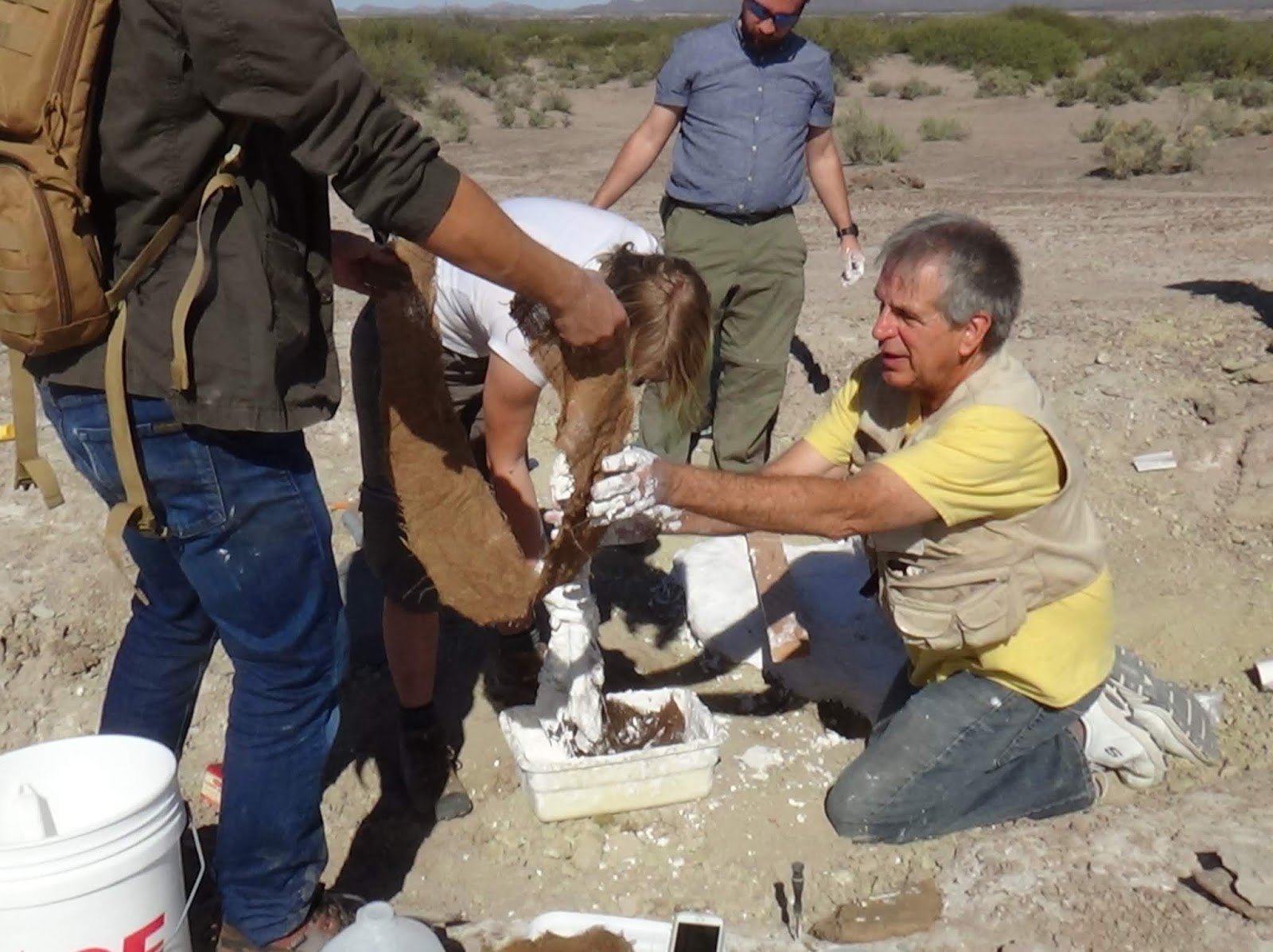
Dipping burlap strips into the plaster to lay on the camel torso.
PC: Jessica Noviello, Nov. 2018.
Next we had to wrap the torso up in plaster to protect it on its journey from desert to museum lab. One volunteer, Emelia, was in charge of making the mixture of plaster and water the exact right consistency, which she called "pancake batter." Another volunteer, Alex, was in charge of ripping up burlap cloth. These burlap strips were dragged through the plaster mix and laid on the torso. We applied at least two layers of burlap and plaster to the entire torso, taking special care around the fragile bits. Finally, we put two wood planks onto the top of the torso, which makes the torso easier to carry and move.
The camel torso ready to be flipped! Rock hammer and blue
stuffed dinosaur for scale. PC: Jessica Noviello, Nov. 2018.

Removing the torso wasn't as easy as just picking it up from the dirt, however. There was still half the torso connected to the dirt underneath the bit we had already excavated. The only solution, therefore, was to flip the torso over. We did this by literally hammering a long rod underneath the torso and using it as a lever. I left the more experienced volunteers to the flipping so I could film it. I was surprised at how quickly it happened. We spent hours preparing the torso, but the actual act of flipping only took about 3 seconds. It was as easy as lifting up on the lever, catching the torso, and lowering it down onto the tarp we had laid out. The tarp allowed us to pick up the entire torso without directly touching it, potentially putting pressure on a weak point in the plaster. Speaking from experience, the tarp made it much easier to carry the torso back out to the cars, though we still needed 4 people to do it.

After we flipped the torso, we were relieved to see that the rod hadn't hit any of the remaining bones, particularly the two legs that were wedged underneath the torso. We were basically drilling blind, so we got really lucky! Unfortunately, the entire torso didn't survive the flip, and some bits and pieces were left behind. We spent the rest of that Saturday closely examining the dirt that was left behind, searching for bone fragments or even some skin impressions. The biggest pieces that were left behind were the ribs, which needed their own plaster jacket before they were moved. You saw these in Part 1 of this blog post.

Bone fragments I picked up while prospecting. Notice the
slight purple tinge and the shiny nature of the bones.
PC: Jessica Noviello, Nov. 2018.
By Sunday there wasn't much left to do on the camel, so I jumped between excavating the turtle shell and prospecting. At first I had a terrible time prospecting. The bone fragments were small and fragmented, so they camouflaged perfectly with the surrounding gravel. I quickly grew frustrated. Thankfully, another member of the Southwest Paleontological Society, Jenny, found a small area that had a bunch of bone fragments, so she called me over to help. I always thought that people exaggerated when they say "once I found one, I easily found tons more," but that's exactly what happened. The bone shards had a slightly purple tinge and a shiny luster that the dull gravel lacked. Once I knew what I was looking for, I couldn't walk two steps without finding more. We carefully put all the fragments into Ziploc bags and labeled them clearly so we had a good record of our data. These bones and bone fragments are true data, evidence of ancient life and a world that doesn't exist anymore. We don't get a second chance to find these if they are lost or destroyed, so we take the process seriously.

Soon after we packed up and covered the remainder of the camel with sand, to be dug up by future groups. The rest of the camel and the turtle headed back to Mesa, where more volunteers would remove the plastic and clean up the bones. I had a great time going out on my first paleontology dig, and if I wasn't in a desperate rush to finish my PhD this spring, I'd be going out again to finish the job. If you are interested in participating in a paleontology dig, I'd first suggest reading up on the subject, and then reaching out to a local museum to get experience working with fossils or in a lab. It is definitely a special experience, and one I am so thankful to have. At the very least, it makes for a great adventure story!
Me digging out the camel torso and preparing it to be flipped.
This is why we use flathead screwdrivers!
PC: Jessica Noviello, Nov. 2018.

Monday, January 14, 2019

I Dug Up a Camel: Part 1

Sometimes the best science opportunities suddenly appear in front of you. In those instances, the best thing to do is say yes and embrace the experience that will one day make a grand adventure story. In November 2018, one of these opportunities knocked me off my feet, literally.

I was training in my Krav Maga class with my partner, an older man named Sherman, and a fellow graduate student, Mariah. We were working on defending against aggressive knife techniques, and one of the defenses ends up with the attacker on the ground, which is how I found myself looking up at my partners with the wind knocked out of me. As I stood up and caught my breath, Sherman asked Mariah and me if we liked paleontology. Turns out Sherman is the President of the Southwest Paleontological Society (SPS), and because he knew that Mariah and I are geology graduate students, he invited us both out to a paleontology dig in eastern Arizona in mid-November. A little over a week later I was in a car driving out to a campground in Safford, Arizona. The hunt for bones was on! Our quarry: a prehistoric camel.

The view from our campground on this dig near Safford, AZ.
PC: Jessica Noviello, 2018.
Our housing at the campground. I was prepared for a tent, but this works too!
PC: Jessica Noviello, 2018.
 Camels have a long history in Arizona that begins 45 million years ago in the Eocene period. Back then, Arizona was a rainforest, and the place where a small, deer-like animal made its appearance in the fossil record: Protylopus. This is the earliest known camel, and its discovery surprised paleontologists. Modern camels, and even most fossil camels, have cushioned, wide feet to help them move over unstable terrain like sand and grassland gravel. But Protylopus walked on four dainty toes on each foot. As southwest North America changed from rainforests to grasslands, these feet put the Protylopus at a mobility disadvantage, and they couldn't overcome it. They eventually died out, but not before starting the lineages that would eventually lead to modern camels.

Artist's reconstruction of Protylopus in its habitat.
PC: WILLEMSVDMERWE and PBS: Eons.

Ancient camels eventually traveled north and west across the landbridge that spanned the Bering Strait, into Asia and Europe, where they became the modern camels we know today. North America and South America finally connected to form the isthmus of Panama around 3 million years ago, leading to a significant migration event called the Great American Interchange. Species that had evolved on one continent quickly moved to the other, including some camels. The camels that migrated south would eventually evolve into the ancestors of llamas and alpacas.

Our camel died after this Interchange event, sometime between 2.2 and 2.4 million years ago. It belonged to the Camelops genus, enormous animals that stood 11.5 feet tall as adults, almost twice as tall as today's camels. Camel skeletons and bones are fairly common throughout the American west, but our camel was unusual for a few reasons. One, our camel was a sub-adult, or a camel teenager; two, our camel was one of three found within a 200 span of an ancient river bed; and three, our camel was complete.
Rib bones of our camel. PC: Jessica Noviello, 2018.

In paleontology, a complete skeleton is one where all of the bones from the skull to the tail are found together, including the small bones found at the ends of the limbs. Turning a dead animal into a fossil takes a long time that ranges from thousands to millions of years depending on the environment. During this time period, scavengers can take bones away from the rest of the skeleton, and natural catastrophes like floods and mudslides can wash bones away.

Finding an entire skeleton is rare. Our camel is only the third complete camel discovered so far in the entire southwest! For this camel to also be a sub-adult makes it even more valuable, as it shows us exactly what that animal looked like at its stage in development as it grew from baby to adult. Its completeness indicates it was buried quickly, before anything could move the bones away. The fact that it was found with two other camels (and an ancient turtle too!) in an old riverbed points to a sudden event, like a flash flood, as the cause of death.

What was it like to dig up the camel? What are the steps involved? Who does stuff like that on their weekends? Find out in Part 2 of this blog post, coming next week!

Additional source:
"When Camels Roamed North America." PBS: Eons. November 20, 2018. https://www.youtube.com/watch?v=lJNoAE0UHzY

Monday, January 7, 2019

Scientific Conferences: AGU 2018

Happy New Year! We here at Science on Main hope you all have a great 2019!

For such a big part of an academic's life, conferences are rarely written about in the world of science communication. The to-do list of things just to attend conferences is long before an attendee even gets there: writing the abstracts, registering, making lodging and travel reservations, doing the proposed work, preparing the posters and oral presentations, and setting up meetings with colleagues are all part of conferences, and that's on top of the official stuff like sessions and workshops! But what happens at these conferences? What's the point of going to them at all? What are they like?

Granted, I can only speak to my own personal experiences at conferences, and each conference has its own particular feeling and style. Some things are similar for all though. It's usually hundreds, if not thousands of people who are all interested in a particular subject arriving at one location to speak to each other face to face. These are not just scientists, as the conferences I go to also have industry representatives who are there to both recruit new employees and sell their company's products. Conferences usually last for a whole work week, and if it's in a new city, I'll try to go at least one day early or stay a day later so I can do some exploring. I know I'm not the only one who does that. It's fun to explore a new city, or even a new country, like I did when I went to Rome, Italy to participate in a conference hosted by the European Space Agency.

The #AGU100 sign outside of the Exhibit Hall at this year's conference.
 The conference I went to in December 2018 was the American Geophysical Union (AGU) Fall Conference in Washington, D.C. It's by far the largest conference I go to because it spans all fields related to geoscience on Earth and elsewhere in the solar system (which is my field: planetary science). This year was special because it was AGU's centennial year, and they were definitely celebrating it. At least 27,000 scientists, exhibitors, students, professionals, volunteers, and organizers came to the nation's capital to share their results and network. Off the top of my head I can't list every discipline represented, but here are a few: planetary scientist, educators, atmospheric chemists, heliophysicists (they study the sun), seismologists, oceanographers, computer scientists, and statisticians. The other main conference I go to is only planetary science, and more specialized conferences mean fewer people attend. It's always good to dive deep into my subject, but I like AGU because it allows me to see techniques and ideas in other fields too.

Perhaps a third of the posters in the poster hall at #AGU100.
I'm guessing the whole thing was 1/4 mile long!
One of the best parts of conferences is how many events there are to go to at any given time, which means everyone can pick and choose what they want to attend. That choice can be a double-edged sword too, since going to one thing means saying no to potentially several others. I try to find friends who will either tweet or take extensive notes during their sessions, that way I never miss anything! This year at AGU I made sure to spend time in a few of the science communication workshops that the Sharing Science division puts on every year, including one that taught me the technical details of how to start a podcast. I came away invigorated and excited to pursue new ideas! This is in addition to the dozens of talks and posters I saw, the volunteering I did at the Arizona State University booth, and the one-on-one meetings I had, of course.

The AGU booth was selling stuffed owls in
sweatshirts. I couldn't resist. It was so cute!
I named him Dr. Whoot.
Speaking of the meetings, that's another major positive about conferences, especially for people who, like me, are approaching graduation and are looking to move to a new position at a new place. At AGU, I was able to meet with senior scientists from all over the country, including NASA Headquarters, to talk to them about potential positions for me. Conferences give young scientists a chance to display their body of work to the entire community and to make connections that will last years, perhaps decades, and many projects. I know of a post-doc who was offered a job the day after he gave his talk, which would not have happened without a conference. For people who are working on projects together, it is always more efficient to meet in person instead of emailing, as questions and concerns are addressed immediately. It improves the quality of the science done too!

Conferences are exhausting and crazy, but they are essential for science to grow and continue. To be able to talk to experts directly about their work increases my knowledge about the field and shows me what work needs to be done in the future. I also gained new collaborators and friends. I've only shared a fraction of the stories I got at this year's AGU, but I hope it was enough to show you a little of what a science conference is all about!

Tuesday, November 27, 2018

Some New InSight

Yesterday the NASA InSight mission successfully touched down on Mars. While it was the eighth NASA mission to reach the red planet's surface, it was the first in a few new categories: first mission to send information via cubesat orbiters, first mission to deploy instruments by itself upon reaching the surface, the first mission to launch from the west coast of the United States, and the first mission to drill into another planet. Sure, all those things sound cool, but why should we care?
Celebrations in the mission control room at JPL in Pasadena, CA after
confirmation of InSight's successful landing came through.
First, a bit of backstory. Every NASA mission that has flown in the past decade has been the winner in a multi-stage selection contest that NASA administrators run. We'll go into more detail in a later post since the process is fairly intricate, but the basics are that many missions submit their plans to a NASA request for proposals, then some of those are selected to move on and create prototypes and more precise mission plans, and from those only one mission is selected. The InSight mission was initially one of 28 mission proposals submitted to NASA in 2010. In May 2011, it became one of three selected from the whole pool to develop more details about the mission and begin some work on building and testing instruments. In August 2012, just days after the Curiosity lander successfully landed on Mars, the InSight mission was selected for development and flight.

InSight uses updated versions of technology that was first included on the Phoenix Mars lander, which successfully landed on Mars a decade ago (2008). To reduce the risks of future missions, NASA likes to select missions that make use of any instrument or mission piece that has already flown on a mission and worked. These missions components are called heritage pieces because they have been inherited down to a newer mission from an older one. The instruments are never exactly the same, even if scientists and engineers want them to be--manufacturers discontinue electronics, technologies improve, etc. Engineers are responsible for extensively testing every single mechanical aspect of the mission in a number of ways--extreme heat, extreme cold, and high radiation are only a few of the environmental factors that a space mission will experience in its lifetime. Of course, the instruments must not only survive, they need to work too, and it's much better to work out issues ahead of time than after launch.

Testing the robotic arm that will deploy the SEIS
instrument. Photo credit: NASA/JPL/Caltech
The seismometer on InSight is a good example of when extensive testing uncovered a problem that could have jeopardized the whole mission. The Seismic Experiment for Interior Structure (SEIS) instrument was built by the French National Space Agency CNES, and will be responsible for obtaining seismic data of Mars, which is effectively the reason that this mission was selected in the first place. Without it, the mission will not be able to collect any seismic information of Mars. Clearly, it was a key part of the mission. During testing, the engineers discovered multiple small leaks in its vacuum chamber that actually holds the seismometer. The leaks were severe enough that the mission's launch date was pushed back from March 2016 to May 2018. The overall cost of this delay was great in both time and money; it cost roughly $150 million to redesign the vacuum chamber, rebuild it, retest it, and pay for the time of the people who worked on it.

InSight launched on May 5, 2018 from Vandenberg Air Force Base in California, a location on the coast in between San Francisco and Los Angeles. Most NASA missions launch from Cape Canaveral in Florida, though some launch from the Wallops Island Flight Facility in Maryland, so InSight is unusual in this regard. Vandenberg was selected because of its good positioning to aim the spacecraft to enter the Mars atmosphere at the correct angle of 12 degrees. Any steeper and the mission would burn up. Any shallower and the mission would "bounce" off the top of the atmosphere and continue off into deep space, lost forever. It was 12 degrees, or failure. If anything, this illustrates to me that there are many precise calculations that go into making every single decision on a NASA mission, and one miscalculation could cost the whole mission.

After 6 months and 301 million miles, InSight finally entered Mars' atmosphere at a perfect 12 degree angle. Much has been written and said about what happened during the landing, so we'll point you to one of our favorites instead of rehashing it here. In about 3 month InSight will deploy its own instruments, including the seismometer and an instrument that will drill 16 feet down into Mars' crust to study the thermal environment of Mars beneath the surface.

A screenshot of the NASA InSight landing live-feed on November 26, 2018, showing the first picture InSight took of Mars' surface. The line in the background is the Martian horizon. The camera lens is still behind the dust cap in this image,  but that piece will be removed in a couple of days, after the dust settles.

Just to prove that it made it to the surface, InSight was programmed to take a couple of pictures at the surface and send them back to us here on Earth. Its relay system is the Mars Cube One (MarCO), an important first for this mission as well. MarCO are two 6U cube sat missions that was designed to relay messages back and forth between Earth and InSight on Mars while it was going through its landing process. What is a cube sat? Generally the larger a mission is, the more expensive it is. A cube sat is a mission that is roughly the size of a shoebox, and it's a type of mission that has become more popular in the past 5 years because they are small, quick and easy to build, and inexpensive. A "U" is a shorthand to refer to the size of a cube sat mission, where a U is a cube with 10 cm sides. A 6U cube sat, therefore, is one that is 30 cm long, 20 cm wide, and 10 cm tall. MarCO was a test to see how well cube sats would work in a deep space environment, one that it passed with flying colors. This will pave the way for future cube sat add-on components to larger missions and even individual cube sat missions (see LunaH-Map here).

All of these accomplishments were the results of years of hard work by its team members and the mission failures that happened before. We thank all the scientists and engineers who have study and do study Mars, and all the people who support them, and wish them all many congratulations! Here's to future breakthroughs on Mars!

Monday, November 19, 2018

Thanksgiving Plants

Last week we told you all about the domestication of the chicken-peacock, a.k.a. the turkey. Since there will be many vegetables present on Thanksgiving tables this week, it's only fair to talk about them too! Here are the histories of some of the most popular plants that we love to eat (or love to hate, we don't judge)!

Sweet potatoes, baked and delicious. Photo from: Food Network
Sweet potatoes: Ipomoea batatas, or the sweet potato, was first domesticated somewhere between the Orinoco River delta area of modern day Venezuela and the Yucatán Peninsula in Mexico around 5,000 years ago. The second name of the sweet potato, batata, is the original Taíno word for the plant, though the Quechua people in Peru call it kumar. Surprisingly, it is only distantly related to the white potato, and is a genetically different plant from a true yam. In fact, the sweet potato is fairly closely related to the morning glory flowers, and the flowers of a sweet potato plant are even called tuberous morning glories! As with most of the plants on this list, it was first introduced to Europe via Spanish conquistadors, and to China via Portuguese traders. Sweet potatoes were used around the world to supplement the lack of other food due to poor harvests or other natural events. For example, after the sweet potato was introduced to Japan in the early 1600s, it became an important plant that prevented starvation in years when the rice harvest was poor. It is a popular plant because it grows well and without pesticides in a variety of climates, though it will not survive the cold and requires roughly 36 inches of water a year to grow.

The Three Sisters plants. Image from:
University of Illinois Extension
Squashes and pumpkins: The domestication of squashes and pumpkins (all part of the genus Cucurbita) is one of the best known stories, and one of the oldest: there is archaeological evidence that puts the domestication of squashes before 10,000 years ago! The wild relatives of squashes produce fruit much smaller than what we know today, and the plants were bitter, even toxic. Only the intense domestication efforts of the indigenous people in Central America saved the squashes we enjoy today. These plants are highly adaptable, and grow in many diverse climates. The reason there are so many types is because they have been traded and transported around the world to many different places, and these plants needed to adapt to survive in their new habitats. The English word squash comes from the Naragansett word askutasquash (a green thing eaten raw), excellent evidence that the plant was able to adapt from its Mesoamerican origins to survive in Rhode Island!

An important point is that squash, beans, and corn are called the Three Sisters of plant husbandry because they are mutually beneficial organisms. Basically, they help each other grow so well that the native peoples in the Americas often planted the three of them together! Squash was the first of the Three Sisters to be domesticated, followed by corn and beans.

Corn: Corn was domesticated from maize by the indigenous peoples roughly 10,000 years ago in what is now southern Mexico. The word "maize" comes from the Spanish version of the original Taíno word for it: mahiz. While the consensus used to be that the Tehuacán Valley was the center of domestication, newer analyses show that the the nearby Balsas River Valley is the true origin point of what we know as corn. A study in 2002 showed that modern corn comes from a single domestication event of maize at least 9,000 years ago, and other studies put this date even earlier. Another study argued that knowledge of corn cultivation was spread through two different events thousands of years apart: one event spread corn cultivation down the Andes Mountains around 6,700 years ago, and the second event spread it across the rest of South America roughly 2,000 years ago. It was taken back to Europe by Spanish conquistadors, and quickly became a popular plant around the world because of its ability to grow in many climates, but it is very sensitive to cold and to droughts, and strong winds can uproot it because of its shallow root structure. Today there are many forms of corn, though most of them are grown for industrial purposes (corn ethanol, animal food, etc.).

Beans: Unlike other plants on this list, beans were known in Europe and around the world before any Spaniard set food on the American continents. The beans that are part of the Three Sisters, however, were originally domesticated in (as you may have guessed) Central America. Some bean remains in the Guitarrero Cave in Peru date beans there to 4,000 years ago, though genetic analysis has proved that those beans were merely cultivated there. Beans, along with corn and squash, gradually spread south as knowledge of their cultivation also spread. Beans need support as they grow, and growing them near corn stalks provided that support. Beans in return pull nitrogen from the air and put it in the ground for corn and squash to use. They grow best in the summer and with lots of water. Currently the genetic information for 40,000 species of beans are held in genebanks, but only 30 of those are actually eaten.
Cranberries on a bush. Photo from: FastGrowingTrees.com


Cranberries: Cranberries were domesticated very recently, only about 200 years ago in Cape Cod, Massachusetts. Before then they were wild plants that the Native Americans would collect and use in a variety of different ways, from preserving fish and meat to mixing them into a poultice to use on wounds. Because the cranberry is a relatively young domesticated plant, it hasn't changed much from its wild variety. Cranberries are closely related to blackberries, huckleberries, and the flower rhododendron (that part blows my mind), and distantly related to the fruits kiwi and persimmon. Most cranberries today are grown in the United States, specifically Massachusetts, Wisconsin, New Jersey, Oregon, and Washington, though they are also grown in five provinces in Canada, and parts of Europe and Chile. They are tough plants but do best in wet, cold regions. Cranberries also are high in polyphenolic antioxidants and have some anti-cancer properties. So, eat up!

We here at Science on Main wish you a very happy Thanksgiving, and thank you for reading!

Sources:
 Zhang, D.P.; Ghislain, M.; Huaman, Z.; Cervantes, J.C.; Carey, E.E. (1999). AFLP Assessment of Sweetpotato Genetic Diversity in Four Tropical American Regions (PDF). : International Potato Center (CIP) Program report 1997-1998. Lima, Peru: International Potato Center (CIP). 
 http://bioweb.uwlax.edu/bio203/2011/keesler_cole/
https://www.sciencedirect.com/science/article/pii/S1055790317301811 
https://www.smithsonianmag.com/smart-news/domestication-saved-pumpkin-and-squash-180957314/
"Origin, History and Uses of Corn". Iowa State University, Department of Agronomy. February 11, 2014.
Piperno, Dolores R. (2011). "The Origins of Plant Cultivation and Domestication in the New World Tropics: Patterns, Process, and New Developments". Current Anthropology. 52 (S4): 453–S470. 
Bitocchi, Elena; Nanni, Laura; Bellucci, Elisa; Rossi, Monica; Giardini, Alessandro; Zeuli, Pierluigi Spagnoletti; Logozzo, Giuseppina; Stougaard, Jens; McClean, Phillip; Attene, Giovanna; Papa, Roberto (3 April 2012). "Mesoamerican origin of the common bean (Phaseolus vulgaris L.) is revealed by sequence data". Proceedings of the National Academy of Sciences. 109 (14): E788–E796. 
https://www.ncbi.nlm.nih.gov/pmc/articles/PMC4076063/